


At MWC 2026 in Barcelona, Lenovo showcased new advances in TRAdA—its end-to-end, AI-powered heart monitoring solution—now being piloted with professional football players in Brazil. The shift from post-surgery monitoring to elite sport is pushing the technology to detect subtler signals, deliver faster insights, and personalize analysis in ways that can support both heart health and performance readiness.
A new proving ground for an AI health monitoring platform
Lenovo first announced TRAdA in October 2024 with a vision to help clinicians and care teams monitor patients in the crucial days and weeks after cardiac surgery. The solution combined a discreet wearable ECG sensor with AI models designed to spot arrhythmia events in near real time, sending critical alerts to a monitoring platform for clinician review.
Armed with life-saving clinical results, TRAdA recently stepped into a dramatically different environment: the training ground of professional athletes.
Lenovo’s R&D team in Brazil began formal testing with professional football players in October 2025, working with São Paulo-based EC Primavera and clinical partners to evaluate feasibility during high-intensity training. In this setting, the “signal” is often harder to find than in cardiac patient: athletes are in peak condition, and meaningful changes in the ECG data can appear as only a few anomalous events across thousands of heartbeats.
That elusive signal is precisely where the latest iteration of TRAdA thrives. Elite sport forces TRAdA’s AI to become more sensitive, more resilient to noise, and more personalized to the individual.
“Only AI can chase something this subtle”
Hildebrando Lima, Director of Lenovo Brazil R&D, described the transition as moving from an environment where symptoms can be more apparent—even to a non-clinician—to one where the patterns are “tiny changes of the waveform.” That’s where machine learning becomes an amplifier for clinicians, narrowing hours of ECG monitoring down to the moments that matter most.
“This is really about the power of AI to transform, enhance, and even save people’s lives,” Lima said. “Our algorithms offer unprecedented pattern recognition with speed, precision, and personalization. And we’ve pushed the AI to rapidly advance in a manner of months, detecting more and more elusive signals.”
What’s new: higher accuracy, broader detection, faster feedback
The latest TRAdA advances are driven less by dramatic hardware changes and more by algorithmic leaps. The monitoring solution has essentially become smarter.
Key advances include:
- Accuracy gains to 97% in arrhythmia detection—up from roughly 93–94% in earlier iterations, based on ongoing testing and algorithm refinement.
- Improved noise and artifact rejection, tackling real-world issues like motion, sweat, and brief signal “glitches” that appear when a user bumps or adjusts the sensor—critical for sport environments.
- More conditions under analysis, expanding beyond atrial fibrillation toward additional rhythm issues (such as supraventricular tachycardia).
- Low-latency, near-real-time processing, enabled by distributing compute across the smartphone and local server.
End-to-end Lenovo technology
“Lenovo is uniquely positioned to deliver the right technology solution at every step of the process,” Lima said. “Device innovation, pioneering AI algorithms, compute at the edge, and a drive to push the limits of technology unite here to make TRAdA possible. I like to call this a ‘heart-to-cloud’ connection.”
- Wearable ECG sensor designed for continuous monitoring (for multiple days, depending on the protocol), built for comfort and everyday mobility.
- Motorola smartphone + dedicated app, used for local data capture and guided symptom reporting (e.g., dizziness, chest pain, shortness of breath), with the phone configured for monitoring-only use to limit distractions.
- Edge/server processing layer, helping analyze dense ECG data quickly and refine predictions in short cycles of only 10 seconds.
- Workstation dashboard for clinical teams, providing “zoomed-in” review of flagged moments so doctors can jump directly to likely events of interest instead of scanning full-day traces.
That seamless interaction is emblematic of Lenovo’s commitment to building hybrid AI ecosystems, as showcased at Tech World 2026.
Personalized AI for accuracy and insight
TRAdA’s addition of professional athletes is also sharpening the key concept of personal baselines. Instead of only comparing an ECG pattern to generalized clinical—which is still valuable—the AI increasingly evaluates waveforms against a person’s own “gold standard” states at rest and during high-intensity training. That context matters in sport, where exertion changes the cardiovascular picture, and meaningful insights may live in small deviations from an individual’s typical pattern. General population averages may differ significantly from athletes when it comes to heart health and activity.
This is also where clinicians stay central: TRAdA can flag and prioritize, but physician review and patient context remain essential to interpretation.
The athlete experience
Players for EC Primavera have enthusiastically embraced the tech, helping refine TRAdA while benefitting from their own health data. The waterproof sensor is discrete and secure enough to fit easily and comfortably. The team leadership enjoys the opportunity to integrate technology into operations.
“Yes, we’re always seeking insight to find a competitive edge, but this also protects our players,” said Doctor Rafael Barnabé Domingues, EC Primavera’s orthopedist. “Our training gets smarter, more data-driven, and more individualized, so we can all excel on the pitch. It’s fantastic technology, and I’ve enjoyed working with Lenovo’s team in Brazil.”
Live demos and further testing
Lenovo showcased TRAdA at MWC 2026 in Barcelona, including live demonstrations of the full workflow, from sensor capture to dashboards interpretation.
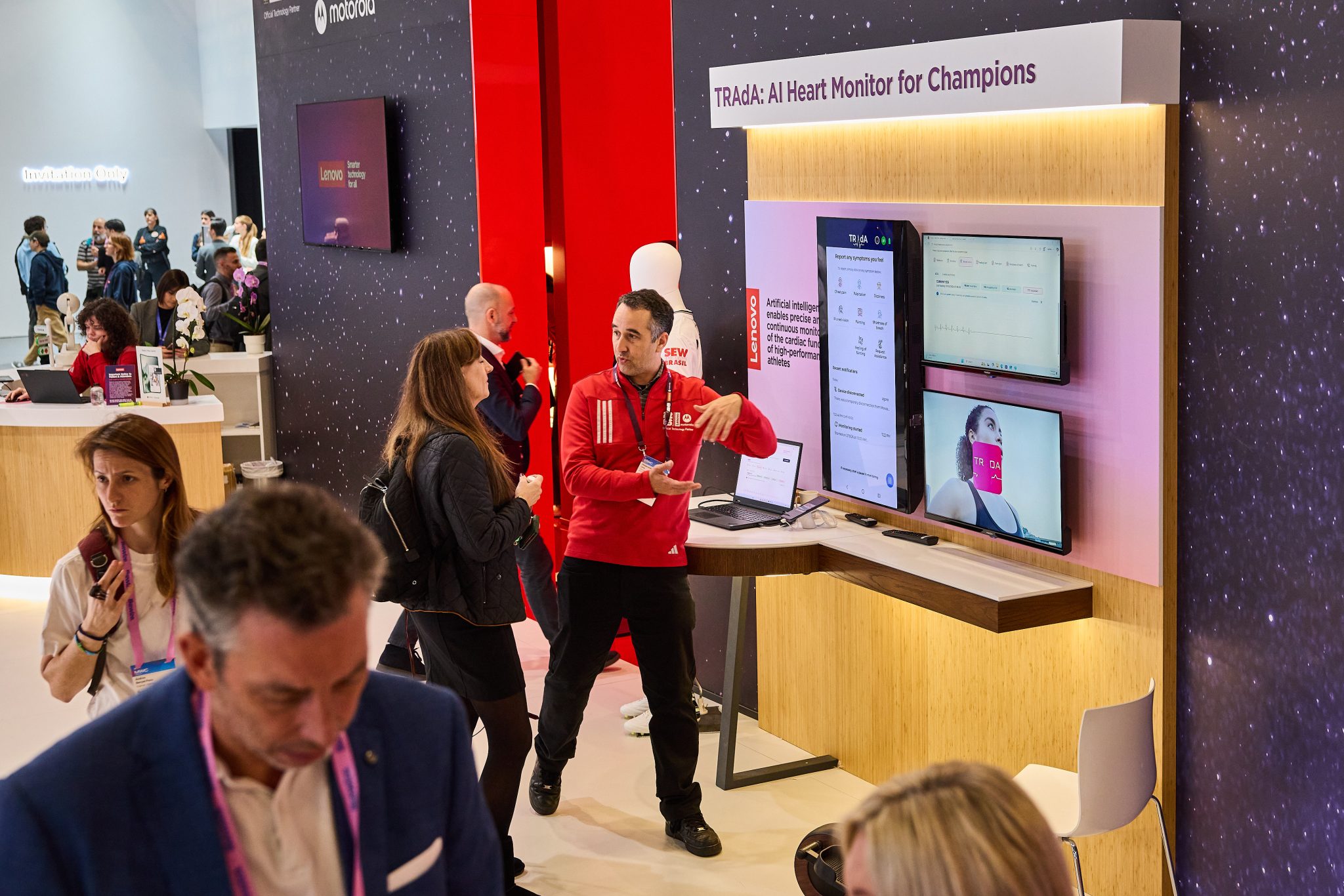
TRAdA’s clinical foundation in Brazil has progressed through multiple test phases, and the broader program continues to move through required medical and government approvals.
Looking ahead, Lenovo’s Brazil team is exploring how the platform could apply to other high-risk or high-stress environments where rapid insight into a person’s cardiac status could be particularly valuable, and where safety monitoring may prevent dangerous incidents.
Built by global R&D, scaled for real-world impact
TRAdA offers a snapshot of Lenovo’s broader approach to transforming R&D and breakthrough technologies including AI, edge computing, and ecosystem integration into real solutions. Partnering with real-world users like EC Primavera and the Brazilian hospitals ensures efficacy and user-centric innovation.
In February 2026, Lenovo announced an expansion of its global R&D footprint with new AI innovation centers in London and Edinburgh, a planned lab in Riyadh, and a Digital Trust Lab in Tel Aviv—reinforcing its focus on deploying AI responsibly, securely, locally, and at speed.